
Start a Bay County Previous-Owner Timeline
Build the chain one transfer at a time. A shared surname is never an ancestor, and a name on the tax roll is never a substitute for the deed itself.
| Transfer date | Grantor to grantee | Deed type | Document or Liber/Page |
|---|---|---|---|
| Newest located transfer | Copy both parties exactly | Warranty, quitclaim, fiduciary, or other | Post-2018 Document Number or older reference |
| Prior transfer | Current row's grantor becomes the next grantee lead | Preserve the instrument label | Copy the cited reference |
| Earlier link | Repeat without omitting intermediate owners | Note corrections or unusual forms | Record book, page, card, or archive series |
Note every change in the legal description, parcel number, or party spelling. That one note may reveal a split, replat, trust, estate transfer, or corrective deed explaining an apparent break in ownership.
Walk a Bay County Deed Chain Backward
The Bay County Register of Deeds offers two routes. It links Doxpop for around-the-clock index access and supports in-house research at the office. The portal displays its own current search controls, so rely on those rather than on any assumed field set or starting year.
- Confirm the present PIN and full legal description.
- Locate and read the newest likely deed.
- Copy its grantor, grantee, recording date, deed type, and reference.
- Search the grantor as a grantee in an earlier date range.
- Compare the earlier deed's land description, then repeat.
- Record every failed variant and switch to the card index or books when online coverage ends.
When the trail blurs, search each party in both grantor and grantee roles. Initials, punctuation, married names, entity suffixes, trustee phrasing, and personal-representative wording can all shift an index result.
Read Bay County Chain-of-Title Terms
Indexes become easier to use when each role and reference is kept distinct.
- Grantor
- The party conveying the interest; in backward research, this is often the next owner lead.
- Grantee
- The party receiving the interest.
- Chain of title
- The linked sequence of instruments affecting the same land.
- Reverse index
- An index organized to find a party in the opposite deed role.
- Warranty deed
- A conveyance carrying stated title covenants.
- Quitclaim deed
- A conveyance of whatever interest the grantor has, without the same covenants.
A deed's type alone proves nothing about title quality. Read the operative text, the legal description, the exceptions, and every reference to earlier instruments before trusting the link.
Keep Document Number and Liber/Page in One Bay County Chain
Bay County citation styles changed on January 1, 2018. Since then, the Register assigns each recorded document a Document Number. Older entries carry a Liber/Page citation. A long deed chain will likely hold both styles. Transcribe whichever style appears, and never try to convert one into the other. The official access routes appear on the Bay County Register of Deeds page.
Record whether you actually read the instrument image or only the index row. An index row is a lead, and it cannot disclose every exception, reservation, easement, or correction buried in the document.
Use Bay County's 1958 to 1984 Card Index
The Register's own page lists a card index spanning 1958 through 1984. When a chain crosses into those decades, or an online result simply disappears, ask which owner card, legal-description card, book, or image series covers the gap. In-house research generally runs from 8:00 a.m. to 4:30 p.m. on weekdays. The office itself stays open until 5:00 p.m.
Coverage limit. The earliest Doxpop year was not confirmed; report that gap and use the card index, deed books, or Register assistance instead of inventing an online cutoff.
For a mailed copy request, the Register asks for a self-addressed stamped envelope. Ask separately whether a plain or certified copy suits your need, since availability differs.
Follow Earlier Bay County Owners into the Archives
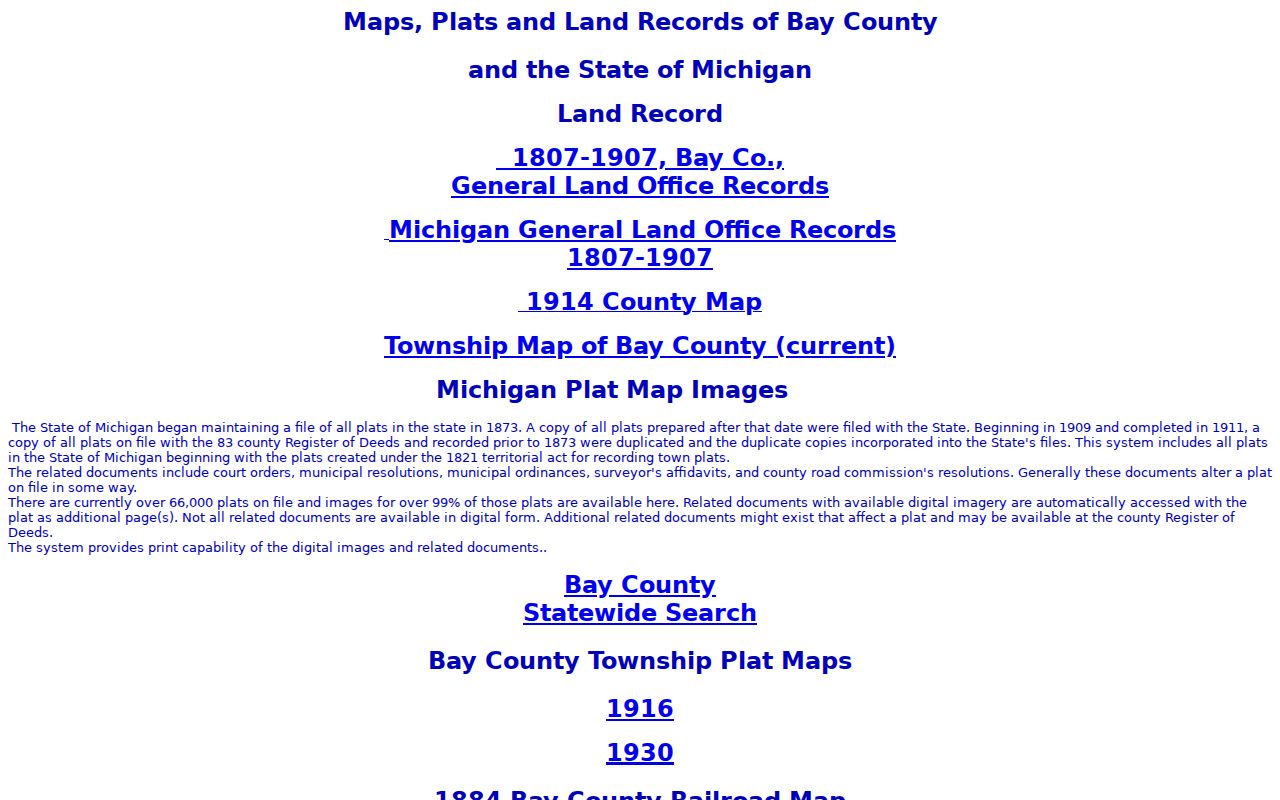
Older owners live in the archives. The Archives of Michigan Bay County guide lists deeds from 1842 to 1886 and mortgages from 1836 to 1917. Deeds are there through 1886, and mortgages run from 1836 to 1917. The county's own historical resources can point you to the right series. The Library of Michigan helps with that too. For operative county land records and certified copies, the Register remains the source. A historic map orients you, but it is never the chain itself. The Bay County historical maps collection offers that orientation.
Log the archive, series, volume or box, and image or page for every item. Note whether you viewed the record itself or merely found it listed in a guide.
Search Historic Bay City Names for Previous Owners
Bay City consolidated with West Bay City in 1905. That changes the vocabulary of older chains. Search both names. Search Lower Saginaw too. Also search additions, outlots, blocks, lots, alleys, and vacated streets whenever those terms surface in a legal description. Center Avenue research alone names Lower Saginaw Addition, Walker's Subdivision of Outlot 10, the Fitzhugh additions, Fraser's First Addition, Birney's Addition, and Carroll Park Plat. It also names Green Avenue Addition, Nurmi's Addition, Washington Court, Center Court, Wells Addition, and W.W. Henry's Addition. Treat these as search clues only. They do not prove a modern address sits in a particular plat. Confirm the description against the deed and the recorded map.
Repair a Break in Bay County Prior Ownership
A missing seller usually has an explanation. Probate, trust administration, a name change, merger, correction, tax foreclosure, or court order can all hide the connection. Each one leaves a trail. Search Probate Court when an estate or personal representative appears. Search Michigan's Business Registry when an entity changes names. Search both old and new PINs after a split. Corrective deeds deserve their own check. They can revise a party name or legal description while citing the first instrument. Compare both images and keep the cross-reference. For a court event, get the actual order from the clerk. MiCOURT is informational, and judicial records are not requested through county FOIA.
Test Every Bay County Previous-Owner Link
Test every row before accepting it. Compare the legal description, parcel identity, party role, transfer date, and cited prior instrument at each link. A similar name or a neighboring lot proves nothing. If the deed cites a retired PIN, follow the land description into the replat, land-division, or assessor mapping record.
| Possible break | Test | Next record |
|---|---|---|
| Name changed | Search both names and roles | Marriage, probate, trust, or entity filing as relevant |
| Description changed | Compare exceptions and acreage | Correction, split, replat, or order |
| Reference missing online | Record search range and warning | Card index, deed book, Register inquiry |
| Estate seller absent | Check authority and sequence | Probate letters, order, fiduciary deed |
Keep unresolved links marked as gaps. A partial chain stated plainly beats a seamless story built on assumptions.
State the Limits of a Bay County Former-Owner Search
A previous-owners timeline reports the transfers you located and their sources. It may not reveal every encumbrance. An unrecorded interest, indexing error, missing image, or adverse claim can also escape it. Call the chain complete only if the relevant record span and legal description were examined. That review must meet an appropriate professional standard. Otherwise, say what you have.
History is not title clearance. Use a title company or attorney for a legal ownership conclusion, especially when a chain contains gaps or corrections.
Preserve the query dates, searched name variants, instrument references, and the exact points where the chain went offline. Those notes make any later property search faster and far more reliable.