
Build a Bay County Owner-of-Record Card
Put the owner conclusion on a single dated card. That way each fact keeps its source, and any conflict between the roll and the deed stays visible instead of buried.
| Record field | Entry to capture | Verification |
|---|---|---|
| Parcel | Full PIN and situs address | FetchGIS and local assessor |
| Roll owner | Name exactly as displayed | Roll year and retrieval date |
| Latest instrument | Grantee and deed type | Recording date and Document Number or Liber/Page |
| Legal identity | Subdivision, lot, section, or other description | Compare deed, map, and plat |
| Open issue | Lag, spelling, entity, estate, or split | Name the next office record |
Phrase results precisely. Write "the roll displays" or "the latest recorded deed names," then attach the date. An index search is not a title examination, and the wording should never blur that line.
Read the Bay County Assessment Roll First
Bay County Equalization posts assessment and tax information through BS&A Online, while city and township assessors keep the property record cards. Search by address or PIN. Save exactly what the live result shows. That means the roll year, owner field, mailing field, local unit, and retrieval date. Matched fields make later deed comparisons far easier.
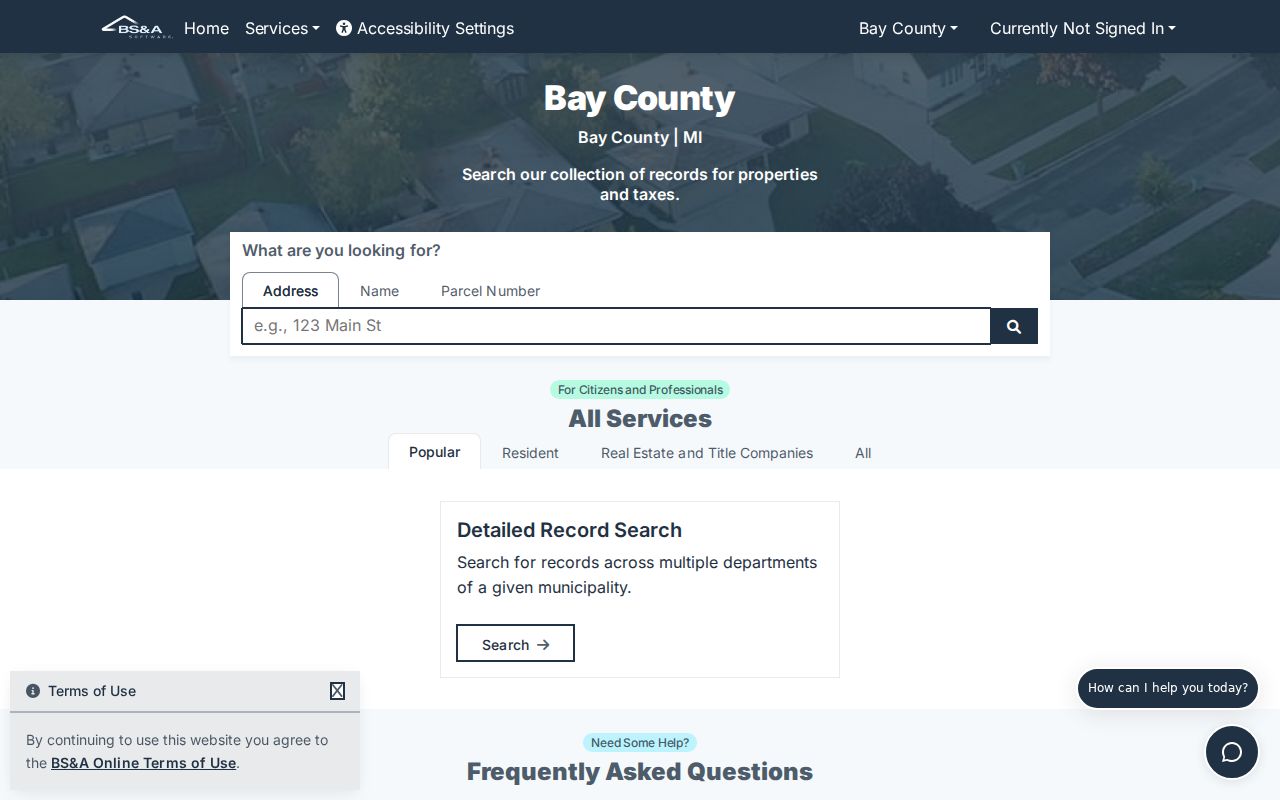
The landing page shows no sample result. Trust only the labels in the live parcel result. For the property record card or a last-update detail, ask the local assessor directly.
Compare the Bay County Current Owner with the Latest Deed
The Register of Deeds records conveyances and links 24-hour Doxpop access. Search the assessor's name as both grantee and grantor, and try variants with initials, punctuation, trustee wording, and entity suffixes. Read the deed image when one is available. Match the full legal description to the subject PIN.
- Start with the confirmed PIN and roll owner.
- Search the owner in both deed-index roles.
- Sort the located transfers by recording date.
- Read the newest likely conveyance, not just its index row.
- Record the grantee, deed type, date, reference, and description match.
Bay County switched to Document Numbers on January 1, 2018. Older instruments still carry Liber/Page references. The Register of Deeds, reachable at 989-895-4228, holds a 1958–1984 card index and an in-house research route for gaps in online coverage.
Resolve a Just-Recorded Bay County Deed
A deed often lands before the roll catches up. Compare the recording date with the roll year. Then ask the local assessor whether the Property Transfer Affidavit has arrived and when the owner field is due to update. Michigan requires that affidavit within 45 days of the transfer.
Dates explain many conflicts. Record the deed date, recording date, roll year, retrieval date, and assessor response before choosing between names.
A roll newer than the deed signals something more. Look for a later conveyance, a correction, a trust instrument, a probate order, or a parcel split. Search both PINs after a parcel split.
Separate Bay County Mailing and Situs Fields
The situs address locates the parcel. The mailing address is for assessment and tax mail. It can point to another city, an agent, a trust, or a company contact. It proves nothing about residence or occupancy. Keep both fields labeled, and skip publishing personal mailing details the parcel question does not need.
- Current owner
- The name a stated source displays as of a stated date.
- Owner of record
- A source-specific label, not a guarantee that every title interest has been examined.
- Situs address
- The address assigned to the property location.
- Mailing address
- The destination used for official correspondence.
- Roll year
- The assessment period that gives context to the displayed fields.
Michigan's Address Confidentiality Program makes agencies use substitute addresses for qualifying participants. Never cross-match databases to expose a protected address.
Confirm the Current Owner with the Right Local Assessor
Bay City, Essexville, Auburn, and the townships keep their own assessment functions even with the county portal link. Find the actual local unit. ZIP codes never draw municipal boundaries.
Bay City runs its own assessment and mapping routes. Essexville warns its online data may lag. Auburn's assessor page covers local assessment and the principal residence exemption. Any request should include the PIN, address, roll year, and the exact field or transfer conflict to check.
Identify a Bay County Company, Trust, or Estate Owner
When the grantee is an LLC or corporation, search Michigan's Business Registry by exact name or file number. Watch for name changes and mergers. Never swap the deed's entity name for an officer's. For a trustee, personal representative, or estate, go to Probate Court for the case, letters, or order that explains authority. Then locate any recorded deed or affidavit.
A court index is a lead, not the court file. Bay County court records come straight from Circuit, District, or Probate, because the judiciary sits outside county FOIA. Keep the case number with your deed notes.
Use GIS as a Bay County Ownership Cross-Check
FetchGIS can display a parcel owner and shape. That label syncs on its own schedule, which may not match the assessment roll. Use it to confirm the PIN. GIS is no substitute for the deed. It cannot set a boundary.
When GIS, the roll, and the deed disagree, build four columns: source, displayed name, source or update date, and next check. A changed legal description calls for the replat, land-division record, correction, or court order, while a stray map label just calls the mapping office.
Document a Defensible Bay County Current Owner Result
Save the source URL, retrieval date, parcel number, legal description, owner or party role, instrument reference, and whether an image was viewed. Log every disclaimer and coverage limit too. That small evidence log makes the result repeatable. It also spares the next researcher a false match.
Current owner is a dated finding. For a legal or insurable ownership conclusion, obtain the appropriate certified records and a qualified title examination.
A public search can establish a strong owner-of-record lead. It cannot surface every unrecorded claim or replace professional review in a purchase or dispute.